
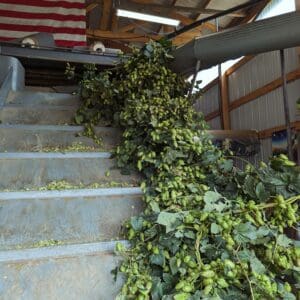
Hops harvested by Crooked Yard Hops.
Montana’s hops industry has come a long way in just a decade. What began as a handful of backyard growers experimenting with locally grown hops has grown into a thriving agricultural sector, with nearly 100 acres of hops now cultivated across the state. From the Flathead Valley to the Gallatin, Montana’s hop farms have become an integral part of the state’s craft beer ecosystem, providing brewers with a local, high-quality product and a compelling story of collaboration between Montana’s farmers and brewers.
At this year’s Montana Brewers Conference in Missoula, the importance of those local connections was front and center during the keynote address from Max Shafer, Brewmaster for Pure Madness Brewery Group (parent company of Melvin Brewing and Roadhouse Brewing, both located in Wyoming). Shafer encouraged brewers to look close to home when sourcing ingredients, especially hops. He emphasized that using Montana-grown hops isn’t just about quality – though he praised their freshness and character – but about building relationships and sharing authentic stories behind the beer. Shafer highlighted how local ingredients can strengthen a brewery’s sense of place. He also pointed to the growing popularity of lagers as a prime opportunity for brewers to showcase Montana hops, declaring that “the American lager revolution is here.”
That optimism is confirmed by the success of this year’s harvest. Across the state, hop growers are reporting strong yields and quality cones. Flathead Valley Hops began pelletizing this week, and brewers can expect 2025 spot orders to start shipping by the end of the month. Available varieties include El Dorado, Cascade, Chinook, Centennial, Vista, Hallertau Mittelfrüh, Saaz, Cashmere, and Sterling, giving Montana brewers plenty of creative options for both classic and experimental styles.
Crooked Yard’s hop harvester at work.
Further south in Bozeman, Crooked Yard Hops wrapped up a successful harvest.
“We are so excited to work with so many breweries again this year and to be able to provide them with high-quality, local hops to make fresh hop beers,” said Jake TeSelle, owner of Crooked Yard Hops. “It’s our favorite time of year to get brewers out to the farm and show them the hard work that goes into their hops!”
Montana’s brewers didn’t waste time putting those hops to use. This year saw an impressive variety of fresh hop beers brewed across the state, from bright, floral lagers and crisp West Coast–style pilsners to bold IPAs. A few breweries pushed the boundaries even further, including Bar 3 Brewing with their Fresh Hop Black IPA and Tamarack Brewing, who crafted a Smoked Hop Stout using El Dorado hops they cold-smoked in-house. These creative takes on the harvest reflect both the skill of Montana’s brewers and the versatility of locally grown hops.
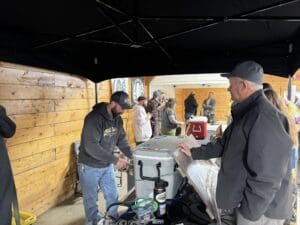
Attendees enjoying brews at the Montana Fresh Hop Festival.
Beer lovers had the chance to taste the results at the 8th Annual Montana Fresh Hop Festival, Saturday, October 18, from 3:00 to 8:00 pm, in Bozeman at the Gallatin County Fairgrounds in Barns #1 and #2. A fundraiser for Gallatin Valley Land Trust, the event brought together breweries from across the state to showcase their fresh hop creations and celebrate the close connection between brewers and growers. By All Means Brewing returned and defended their Iron Cone Trophy, becoming three-time people’s choice winners for their Dew Point Fresh Hop IPA.
For more information on the event, visit mtfreshfest.com. Whether you’re a brewer, a hop farmer, or a fan of Montana beer, the Fresh Hop Festival is a celebration of local flavor, collaboration, and the spirit of the harvest — the perfect way to toast another successful season for Montana hops.
On Saturday, October 11th, the Brewers Association revealed the award-winning beers featured at the Great American Beer Festival’s competition ceremony. As they have each year since 2002, a Montana brewery received a medal at the United States’ largest beer competition.
A total of 273 breweries and cideries took home 347 medals in this year’s competition. Over seven days and three judging phases, 250 beer experts evaluated 8,315 entries from breweries representing all 50 states and Washington, D.C.
“Year after year, the Great American Beer Festival sets the bar for American brewing (and for the second year in a row, cidermaking). The 2025 competition was no exception,” said Chris Williams, competition director for the Brewers Association. “There were extremely strong showings from numerous breweries and cidermakers across the U.S., maximizing the level of competition among the entire competition community. With 347 winners this year, these medals honor the talent, dedication, and creativity of our nation’s brewers and cidermakers.”

Bart Watson, Brewers Association President & CEO, awarding Cranky Sam’s GABF medal to Timmy Evon.
Photo © Brewers Association
In Missoula, Cranky Sam Brewing received their first ever medal at GABF for their Helles, winning bronze in the Munich-Style Helles category. This brew is clean, crisp, and elegant, lagered over a month to encourage a refined, cohesive, and delightfully repeatable experience.
For Cranky Sam’s Co-Owner and Director of Brewery Operations, Timmy Evon, “we couldn’t be more thrilled to win our first GABF medal for Cranky Sam, particularly for such a quintessential German style!” He says he gives “a huge credit to our Head Brewer Ryan Cole for consistently and tenaciously pursuing the best example of these beers possible with the tools at our disposal.”
At Cranky Sam, “few things make us happier than executing and drinking a beer that harkens back to the wonderful times we’ve spent in Bavaria,” Evon continues. “Pulling a medal in a major competition for a lager in this current zeitgeist is a great acknowledgement of the work and passion that go into every beer here.”
Helena’s Lewis & Clark Brewing Co. expanded their medal-winning streak at GABF to three years with a silver medal in American Wheat Beer for their Miner’s Gold. Their most popular brew, Miner’s Gold is an unfiltered Hefeweizen that is gold in color, light in body, and very refreshing.
Photo © Brewers Association
“Our approach here at Lewis and Clark is that the process is paramount to the recipe. What we have in Miner’s Gold is a rock solid recipe AND a production team that always executes our process,” explains Mike Scott, Director of Operations at Lewis & Clark. “My team and I are very thankful for this award as the competition is very tough, and seemingly tougher every year. We are also thankful for our customers, at the end of the day our commitment is to continue to bring the customers world class beer.”
It’s not surprising that a brewery from Big Sky Country received recognition for the de facto state beer style, the Scottish Ale. Diamond X Beer Co., of Billings, received silver in this category. While Diamond X is a first-time GABF medalist, their Caber Tosser Scottish Ale is no stranger to success in major beer competitions. “We felt confident in this recipe because it has also taken bronze in the World Beer Cup in the past,” says Gabe Thom, Head Brewer at Diamond X.
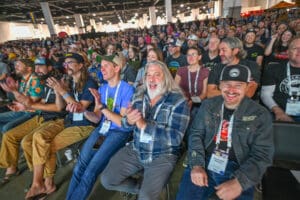
Photo © Brewers Association
While congratulations were in order, news of the win almost missed Thom. “I was actually on a family trip at Snow Mountain Ranch when I got a text from our grain and hops guy Jake [TeSelle] from Montana Craft Malt.” After receiving the cheers, “I then realized that I had missed the livestream of the competition.” Eventually, Thom found out that Caber Tosser received its recognition, and explains that “I am honored to receive this medal for Diamond X, and want to say thanks to Jake for the heads up!”
A GABF medal is among the most prestigious a brewer can receive, and is an incredible accomplishment for each of these breweries. For more information and a complete list of winners from the GABF competition, visit www.greatamericanbeerfestival.com.
The annual Montana Brewers Rendezvous tour concluded on Saturday, September 6th, with the Fall Rendezvous brewfest in Missoula. 30 breweries from across the state packed into Caras Park, pouring over 100 individual brews for beer lovers to sample and savor.
Soundtracked by performances from John Floridis and Tom Catmull’s Last Resort, the Fall Rendezvous was the culmination of three craft beer celebrations across Montana organized by the Montana Brewers Association. This year’s tour kicked off in Bozeman in May, before travelling to Helena in August.
Before festivalgoers savored the suds, a group of 10 beer judges tasted and assessed the Rendezvous’ selections, scoring them in 14 style categories. After careful consideration, when the results were in, MBA Executive Director Matt Leow announced the award winner in each category, plus Best in Show, during the VIP hour. The competition is a chance to recognize the excellent beers handcrafted across Montana, point attendees to some of the best selections, and give brewers feedback from experienced judges to improve their beers.
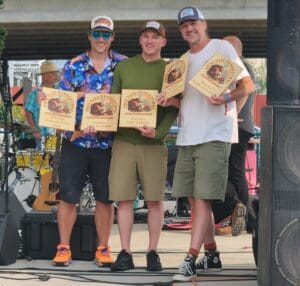
From left, Matt Leow, Mark Bergstrom, and Dave McAdoo display Bozeman and Burnt Tree Brewing’s brewfest hardware.
“The MBA Fall Rendezvous brewfest is by far our favorite primarily because it is composed entirely of fellow Montana breweries,” says Burnt Tree Brewing’s head brewer, Dave McAdoo. “The camaraderie with fellow MT brewers and industry folks, most of whom are bringing their best beers to share and show off, lends a ‘familial’ vibe to the event.”
Taking home the Best in Show Award was the Funky Forester Belgian Blend, a collaboration between Bozeman Brewing Company and Burnt Tree Brewing. The two breweries merged three different ales into one, melding a saison, an unfruited lambic, and a barrel-aged Brett tripel into a slightly tart farmhouse fusion with an earthy, funky finish. This unique mixture, which also received top honors in the Belgian-Style Ales category, features notes of honeysuckle, apricot, white grape, and oak.
 “We’re always appreciative of any recognition we receive for our beers, especially considering the quality of our fellow brewers and the community we have across Montana,” says Bozeman Brewing’s sales manager Mark Bergstrom. “This time around was extra fun because we got to brew and win with our friends Dave and Scott.”
“Earlier this year, we were honored to have been invited to brew collaboration beers with Bozeman Brewing. The fact that our collaboration beer is now a multiple award-winner shows that the creativity, love and intent is evident in the resulting beer,” adds McAdoo.
Here’s the full list of award winners at the Fall Rendezvous:
Best in Show: Bozeman Brewing Company (collaboration with Burnt Tree Brewing) – Funky Forester Collab Belgian Blend
Amber or Dark Lagers: Copper Furrow Brewing – Tmave Czech Dark Lager
Amber, Red or Brown Ales: Copper Furrow Brewing – Brandon’s Brown English Brown
Belgian-Style Ales: Bozeman Brewing Company (collaboration with Burnt Tree Brewing) – Funky Forester Collab Belgian Blend
Blond, Cream, or Wheat Ales: Jeremiah Johnson Brewing Company – Kolsch
Dark Ales: Blackfoot River Brewing – Black Ale
Experimental Beers: Madison River Brewing Company – Salmon Fly Honey Rye Ale
Fruit, Vegetable, or Spiced Beers: Burnt Tree Brewing – MargaWheata Fruited Wheat
Hard Seltzer or Kombucha: Beehive Basin Brewery – Violet Beauregard Blueberry Seltzer
Hazy IPAs or Hazy Pale Ales: Bridger Brewing – Chasin’ Haze Hazy IPA
IPA: Cranky Sam Public House – Bluebird Mountain IPA
Pale Ale: MAP Brewing Co. – Sunshine Daydream Pale Ale
Pale Lagers: Bozeman Brewing Company – Saru Zen Japanese-Style Rice Lager
Sour Beers: Mighty Mo Brewing Company – Strawberry Rhubarb Sour Ale
Wood Aged Beers: Burnt Tree Brewing – Pink Boots Barrel Aged Doppelbock
Montana’s largest educational gathering for brewery professionals, the Montana Brewers Conference, brought together brewers and industry partners to the Holiday Inn Downtown in Missoula on September 4th and 5th. With economic headwinds slowing brewery growth around the country, remaining resilient has been a hot topic within the craft brewing community.
Sharing their knowledge at the conference was keynote speaker Ashleigh Carter. Carter, the head brewer and co-owner of Denver’s Bierstadt Lagerhaus, oversees production at the lager-only brewery that’s been a staple in Colorado’s brewing scene since 2016.
 Addressing a plenary meeting of Montana brewers, Carter provided attendees a perspective on resiliency and burnout in the brewing industry. Beginning with a deep dive into burnout, Carter outlined its signs and impacts on an organization. Burnout includes feelings of exhaustion, leading towards declining performance and attitudes toward themselves and other people. In a brewery, this creates worse brews and strained relationships.
To combat these symptoms, organizations should take proactive steps to mitigate burnout in their staff. This includes recognizing the signs as they build, and creating strategies to deal with it. This includes building resilience, or the ability to adapt to challenging situations. Creating resilience requires recognizing your strengths and being honest, combined with creating relationships with those you can trust. This means that resilience goes from being an idea to a tangible quality one can assess.
Other ways to combat burnout include developing a mission statement for an organization. This creates a common goal brew crew members can work towards. For Bierstadt, this means recognizing beer’s central place in creating connections in human history, and working to spread that experience through well crafted lagers.
Another challenge brewers face is the struggle to rationally adapt to the irrational business of brewing. A single atlas to guide a brewery doesn’t exist, and it is a struggle to find balance in an unbalance ecosystem. Using a nautical metaphor, Carter explains that anchors or sails are ways to respond to setbacks in business. This means having the ability to be flexible or rigid in response to challenges, and being able to identify whether one should move forward, go back, or stay put.
Finally, Carter highlighted the key differences between adaptation and evolution. Adapting is a short-term process to suit variable conditions, while evolution involves changing and developing over time. Brewers should be able to use both strategies as winds shift in the brewing industry, Carter argues. Having the ability to adapt to trends is critical, while identifying strategies to evolve helps brewers to make changes needed to thrive.